The Temporary Dwellings
A Sukkot study on temporary dwellings, wilderness remembrance, and the symbolism of the fragile booth.
ARTICLE 7.1: THE TEMPORARY DWELLINGS
Series 7: Chag HaSukut (The Feast of Tabernacles) The Biophysics of the Sukkah and the Reality of Terrestrial Exile
Following the absolute purification of the camp on Yum Kipuriym, the Qahal enters the most joyful and immersive appointed time of the year: Chag HaSukut (The Feast of Tabernacles). To observe this feast properly, the believer is commanded to physically alter their living arrangement for seven continuous days.
This is not a symbolic mental exercise; it requires the construction of, and dwelling within, a highly specific architectural structure known as a Sukkah. In the Qadamuni restoration, the Sukkah serves as a profound biophysical interface, reminding the remnant of their fragile terrestrial existence and their total dependence on the continuous provision of 𐤉𐤄𐤅𐤄.
The Architecture of Fragility and Organic Life
The Turah explicitly commands the Qahal to leave the comfort of their permanent homes and move into temporary shelters constructed from specific terrestrial elements.
“Ye shall dwell in booths (Sukut) seven days; all that are Yashar’al born shall dwell in booths: That your generations may know that I made the children of Yashar’al to dwell in booths, when I brought them out of the land of Matzrayim: I am 𐤉𐤄𐤅𐤄 your Alahiym.”
— Wayiqra (Leviticus) 23:42-43
“And ye shall take you on the first day the boughs of goodly trees, branches of palm trees, and the boughs of thick trees, and willows of the brook; and ye shall rejoice before 𐤉𐤄𐤅𐤄 your Alahiym seven days.”
— Wayiqra (Leviticus) 23:40
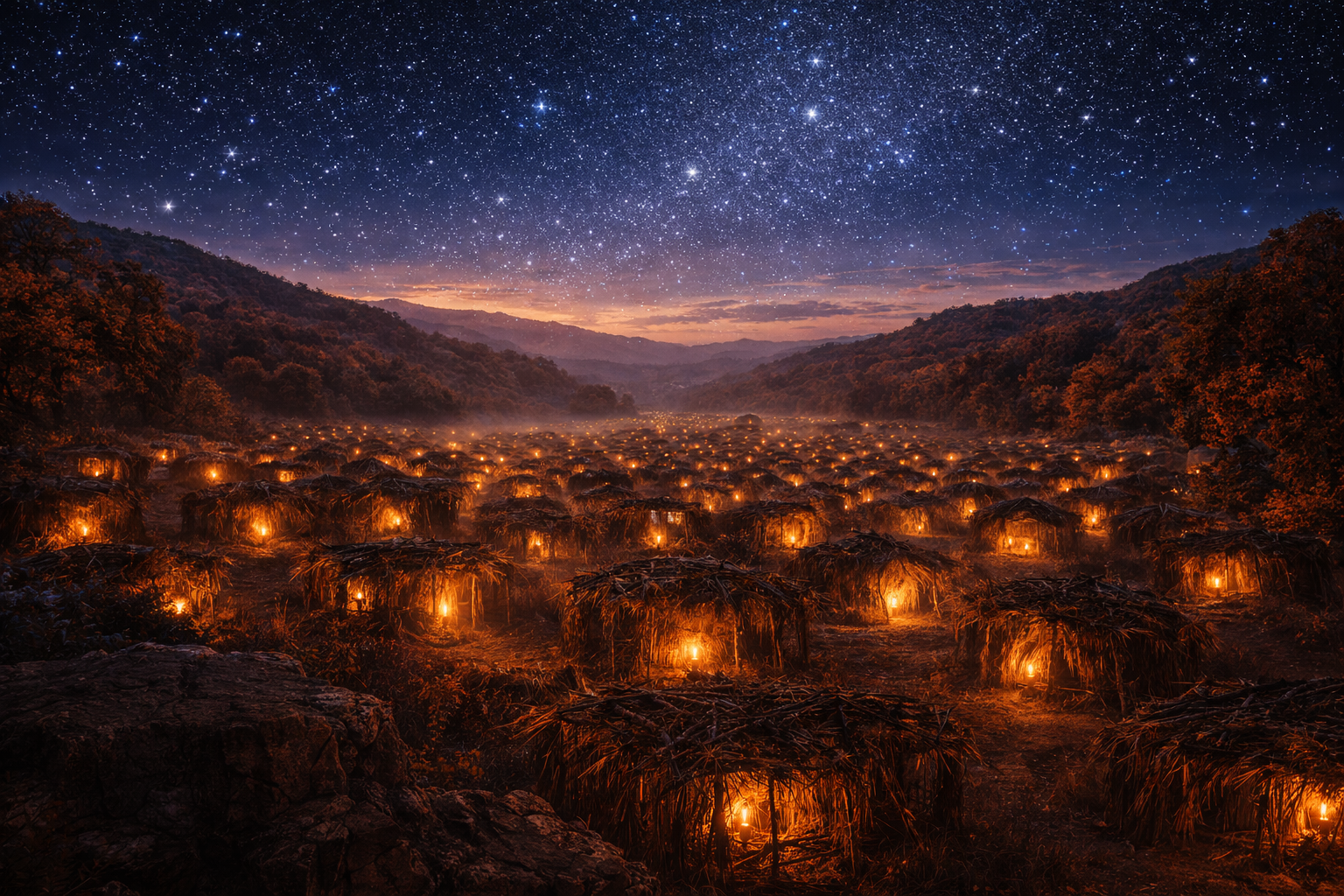
A valid Sukkah must be constructed of organic, living materials harvested from the earth. Its most critical component is the s’chach (the roof). The roof must be dense enough to provide shade from the harsh sun, yet sparse enough that the stars of the Heavens remain visible through the branches at night.
The Biophysical Lesson: The architecture of the Sukkah is deliberately fragile and intensely organic. This stands in absolute, violent contrast to the architecture of Babylon. When the world gathered in rebellion at Babal (Babel), they built a tower using dead, artificial materials: fired brick and slime (bitumen) to create impenetrable, unnatural walls (Barashiyth 11:3).
Babylon teaches humanity to build thick walls, high towers, and massive bank accounts to secure their existence independently from the Creator. The organic, fragile Sukkah forces the Qahal to dismantle that illusion. We step out of our artificial fortresses and remember that true security is found only beneath the direct, unmediated covering of the Heavens.
Remembering the Wilderness and the Return from Babylon
The primary historical context of the Sukkah is the wilderness journey following the extraction from Matzrayim (Egypt).
When Yashar’al crossed the Yam Suph, they had no cities, no fortresses, and no permanent infrastructure. They lived entirely in tents and temporary booths. Yet, they were more protected in those fragile shelters than they had ever been behind the massive stone walls of Pharaoh’s cities.
Why? Because the acoustic and visual presence of 𐤉𐤄𐤅𐤄—the pillar of cloud by day and the pillar of fire by night—rested directly over their camp.
“And 𐤉𐤄𐤅𐤄 went before them by day in a pillar of a cloud, to lead them the way; and by night in a pillar of fire, to give them light; to go by day and night.”
— Shamut (Exodus) 13:21
Centuries later, when the remnant was extracted from their second great exile in Babylon, the Tirshatha (Governor) Nachamyahu (Nehemiah) and the scribe Azra recognized that the physical walls of Yarushalayim were useless if the spiritual perimeter was broken. They immediately commanded the people to construct Sukut, a practice that had been largely abandoned during the monarchy and the exile:
“So the people went forth, and brought them, and made themselves booths (Sukut), every one upon the roof of his house, and in their courts, and in the courts of the house of Alahiym… And all the congregation of them that were come again out of the captivity made booths, and sat under the booths: for since the days of Yahushua the son of Nun unto that day had not the children of Yashar’al done so. And there was very great gladness.”
— Nachamyahu (Nehemiah) 8:16-17
The seven days of Chag HaSukut forcefully recreate this dynamic for the remnant today. As the Qahal sits in the fragile Sukkah, eating their meals and looking up through the branches, they remember that survival does not depend on the strength of the walls around them, but on the presence of the Kabad (Glory) above them.
The Biological Mishkan (Our Mortal Bodies)
In the advanced physics of the New Covenant writings, the emissaries utilized the exact architecture of the Sukkah to explain the nature of human biology.
The human body is a temporary, terrestrial vessel. It is a “Biological Mishkan”—a tent designed to house the Ruach (Spirit) for a brief duration. The emissary Sha’ul (Paul) made this connection explicit:
“For we know that if our earthly house of this tabernacle (Sukkah/Tent) were dissolved, we have a building of Alahiym, an house not made with hands, eternal in the heavens. For in this we groan, earnestly desiring to be clothed upon with our house which is from heaven.”
— 2 Qurintiyiym (2 Corinthians) 5:1-2
The physical body, like the Sukkah constructed of branches, is subject to the elements. It ages, it degrades, and it is ultimately temporary. By living in the Sukkah for seven days, the Qahal rehearses the reality of their mortality. We are currently in terrestrial exile. This corrupted earth is not our final destination, and these fragile biological bodies are not our permanent state.
The emissary Kaphah (Peter) also recognized his physical body as a temporary tabernacle that he would soon fold up:
“Yea, I think it meet, as long as I am in this tabernacle, to stir you up by putting you in remembrance; Knowing that shortly I must put off this my tabernacle, even as our Adunay Yahushua Mashiach hath shewed me.”
— 2 Kaphah (2 Peter) 1:13-14
Even the Mashiach himself submitted to this temporary architecture. When Yahushua was incarnated, he put on the fragile “tent” of human flesh to dwell among the camp of Yashar’al:
“And the Word was made flesh, and dwelt (tabernacled) among us, and we beheld his Kabad, the Kabad as of the only begotten of the Father, full of Chan (favor) and truth.”
— Yahuchanan (John) 1:14
The Posture of Rejoicing in the Ultimate Shield
Despite the extreme fragility of the Sukkah and the reality of our earthly exile, Chag HaSukut is commanded to be the most joyous feast of the year.
“And thou shalt rejoice in thy feast, thou, and thy son, and thy daughter, and thy manservant, and thy maidservant, and the Lawiy, the stranger, and the fatherless, and the widow, that are within thy gates.”
— Dabariym (Deuteronomy) 16:14
How can the Qahal rejoice in a state of fragility? Because the temporary nature of the Sukkah is the exact proof that the exile will end. We rejoice because the harvest has been gathered, the sins have been atoned for on Yum Kipuriym, and the King is in our midst.
Furthermore, the prophet Dawid (David) revealed that the true Sukkah is not the one we build with branches, but the protective acoustic and spiritual perimeter generated by 𐤉𐤄𐤅𐤄 Himself during times of warfare and tribulation:
“For in the time of trouble he shall hide me in his pavilion: in the secret of his tabernacle (Sukkah) shall he hide me; he shall set me up upon a rock.”
— Tahiliym (Psalm) 27:5
The Sukkah teaches the remnant to hold the things of this world loosely. We build, we plant, and we labor in Babylon, but we do so knowing that these stone walls will fall. We rejoice in our fragile tents today because we know that the true, eternal Kingdom—the New Yarushalayim—is descending.
Study Path
Continue the Maw'adiym Path
Follow the next step in this appointed-time sequence through the linked Maw'adiym studies below. These connected articles help keep the full chronology, feast structure, and restoration flow together as one study path.