The Final Week of Yahushua
A biblical chronology study on the final week of Yahushua, the three days and nights, and the spring feast timeline.
ARTICLE 1.3: THE FINAL WEEK OF YAHUSHUA
Series 1: Pasach (The Passover) Harmonizing the Basurah: The Ultimate Lamb on the Atz
The traditional Christian timeline of “Good Friday” to “Easter Sunday” is a chronological impossibility. It mathematically destroys the only sign the Mashiach gave regarding his death—the sign of Yunah (Jonah)—and it entirely detaches Yahushua from the precision mechanics of the Turah.
The confusion stems from a fatal double-error: attempting to read the Basurah (Glad Tidings) through the lens of a Roman Gregorian calendar and a Pharisaic sunset-to-sunset day. When we place the final week back onto the 364-day Tzadokite Master Clock and recognize that the Yum (Day) begins exactly at sunrise, the timeline of the ultimate Lamb harmonizes flawlessly.
The Sign of Yunah (The Three Days and Nights)
Yahushua was repeatedly challenged by the Pharashiym and the Scribes to produce a sign proving his authority. He rejected their demands for atmospheric phenomena and gave them only one, highly specific chronological metric.
“But he answered and said unto them, An evil and adulterous generation seeketh after a sign; and there shall no sign be given to it, but the sign of the prophet Yunah: For as Yunah was three days and three nights in the whale’s belly; so shall the Son of man be three days and three nights in the heart of the earth.”
— Matityahu (Matthew) 12:39-40
A Friday afternoon death and a Sunday sunrise resurrection allows for only two nights and, at best, one full day. It is a mathematical failure. To fulfill the prophecy and validate his identity as the Mashiach, Yahushua had to be entombed for exactly 72 hours: three full daylight periods and three full periods of darkness.
The High Day Confusion
The primary error in traditional theology is the misunderstanding of the “Preparation Day.” The Basurah explicitly states that Yahushua was placed on the Atz on the preparation day. Rome assumes this means Friday (the preparation for the weekly Shabat). However, the Turah designates multiple “High Sabbaths” throughout the year that are completely independent of the weekly seventh day.
“The Yahudiym therefore, because it was the preparation, that the bodies should not remain upon the stake on the sabbath day, (for that sabbath day was an high day,) besought Pilate that their legs might be broken, and that they might be taken away.”
— Yahuchanan (John) 19:31
According to the Tzadokite 364-day calendar:
-
Pasach (Month 1, Day 14) always falls on a Tuesday.
-
Chag HaMatzut (Month 1, Day 15), the first day of Unleavened Bread, always falls on a Wednesday.
Therefore, the “High Day” Sabbath mentioned by Yahuchanan was Wednesday, the 15th of Abib. The preparation day for that specific High Sabbath was Tuesday, the 14th—the exact day the physical Pasach lambs were being slaughtered.
The 364-Day Sequence of the Final Week
By applying the sunrise epoch (the day begins at dawn, not sunset), the timeline lock-steps perfectly with the Turah:
-
Monday Evening / Tuesday Pre-Dawn (The Final Meal):
-
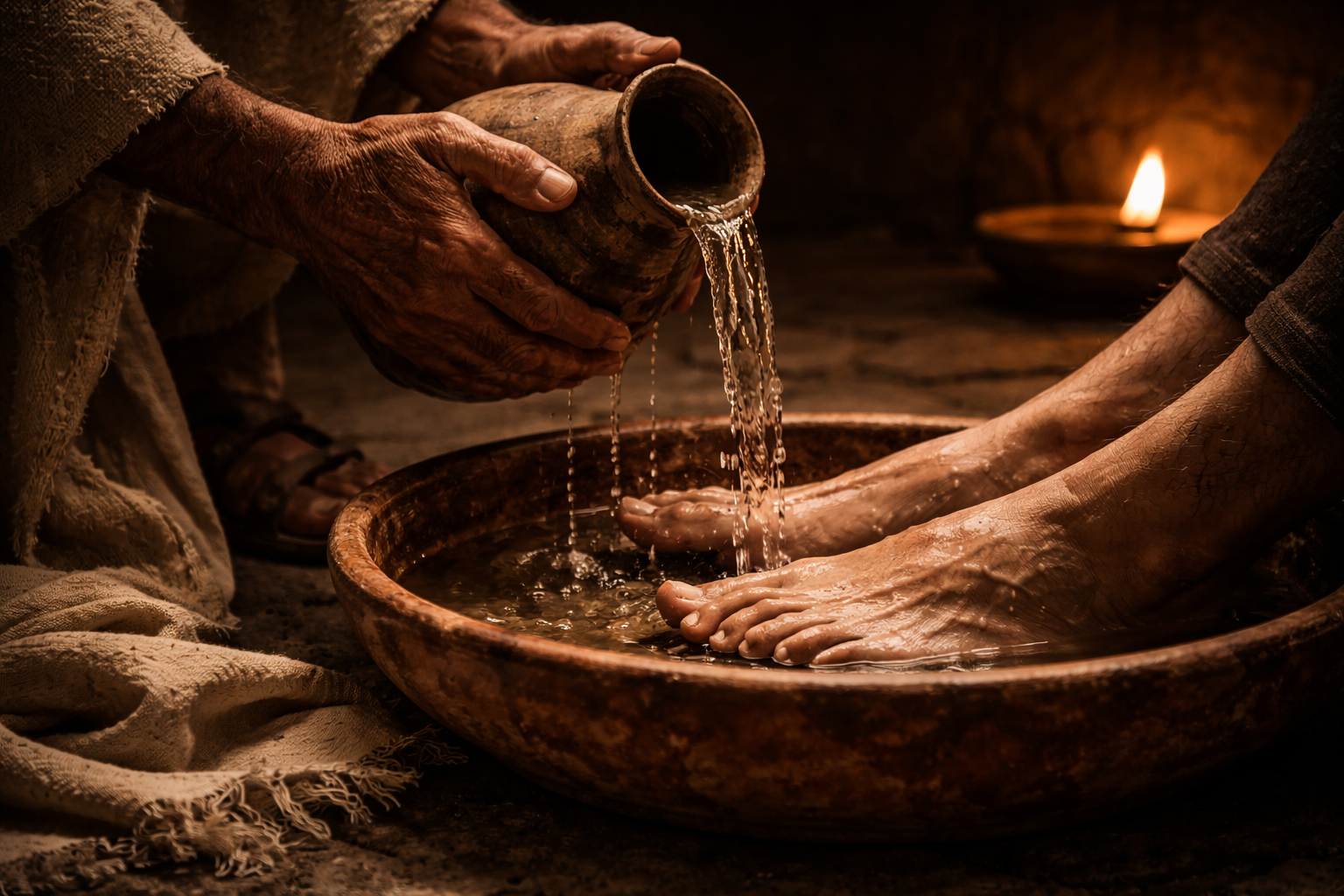
Knowing his time is short, Yahushua eats a meal with his emissaries during the darkness prior to the 14th day. This is when he institutes the foot washing and the cup of the renewed covenant.
-
“And he took bread, and gave thanks, and brake it, and gave unto them, saying, This is my body which is given for you: this do in remembrance of me.”
— Luqas (Luke) 22:19
-
Following the meal, he is betrayed by Yahudah (Judas) in the garden and illegally tried through the night.
-
-
Tuesday (Month 1, Day 14 - Pasach):
-
Sunrise: The true 14th day officially begins. Yahushua is brought before Pilate.
-
The Third Hour (9:00 AM): He is nailed to the Atz. (Marqus/Mark 15:25)
-
The Ninth Hour (3:00 PM): Yahushua gives up the Ruach (Spirit) and dies, precisely as the Kahaniym begin slaughtering the national Pasach lambs in the Haykal. (Luqas/Luke 23:44-46)
-
Before Sunset: Because the High Sabbath of Chag HaMatzut is approaching at the next sunrise, he is hurriedly placed in the tomb of Yausaph of Ramatayim.
-
-
Wednesday (Month 1, Day 15 - Chag HaMatzut):
-
This is the “High Day” Sabbath. Strict rest is commanded. The women rest.
-
Night 1 / Day 1 in the tomb.
-
-
Thursday (Month 1, Day 16):
-
The High Sabbath has passed. The merchants are open again. The women purchase spices to anoint his body, but must prepare them before the weekly Shabat arrives.
-
“And they returned, and prepared spices and ointments…”
— Luqas (Luke) 23:56a
-
Night 2 / Day 2 in the tomb.
-
-
Friday (Month 1, Day 17 - The True Preparation Day):
-
This is the preparation day for the normal weekly Shabat.
-
Night 3 / Day 3 in the tomb.
-
-
The Weekly Shabat (Month 1, Day 18):
-
The women rest according to the 4th Commandment.
-
“…and rested the sabbath day according to the commandment.”
— Luqas (Luke) 23:56b
-
As the sun sets on the weekly Shabat (entering the darkness before Sunday morning), the 72 hours (three days and three nights) are perfectly complete.
-
“The first day of the week cometh Maryam Magdalene early, when it was yet dark, unto the sepulchre, and seeth the stone taken away from the sepulchre.”
— Yahuchanan (John) 20:1
Yahushua had already risen. The timeline of the Heavens is flawless. He fulfilled the sign of Yunah exactly. He became the ultimate Pasach sacrifice, his blood providing the permanent biological and spiritual quarantine for the remnant. The law of sin and death was shattered by the precise, unbreakable physics of the Turah.
By stripping away the Roman calendar and the Pharisaic evening epoch, the Qahal can witness the perfect architecture of the Heavens operating through the Mashiach.
Study Path
Continue the Maw'adiym Path
Follow the next step in this appointed-time sequence through the linked Maw'adiym studies below. These connected articles help keep the full chronology, feast structure, and restoration flow together as one study path.