Counting the Sabbaths
A Feast of Weeks study on counting the Sabbaths, the morrow after the Shabbat, and the bridge from spring into summer.
ARTICLE 4.1: COUNTING THE SABBATHS
Series 4: Chag HaShabu’ut (The Feast of Weeks) The Mathematical Bridge from Spring to Summer
Unlike the designated Spring and Fall intersections, which are assigned static calendar dates (such as the 14th day of the first month), the Summer Intersection must be actively calculated. 𐤉𐤄𐤅𐤄 designed Chag HaShabu’ut (The Feast of Weeks) as a destination that the Qahal must journey toward through strict chronological obedience.
To arrive at the correct appointed time to receive the transmission of the Ruach HaQudash, the remnant must build a 50-day mathematical bridge, beginning exactly at the coordinate of the resurrection.
The Starting Coordinate: The True Morrow After the Shabat
The Turah gives highly specific instructions on when to initiate the 50-day count. The starting point is Bikuriym (Firstfruits)—the day the wave sheaf was elevated.
“And ye shall count unto you from the morrow after the Shabat, from the day that ye brought the sheaf of the wave offering; seven Sabbaths shall be complete: Even unto the morrow after the seventh Sabbath shall ye number fifty days; and ye shall offer a new meat offering unto 𐤉𐤄𐤅𐤄.”
— Wayiqra (Leviticus) 23:15-16
A massive chronological corruption was introduced by the Pharashiym (Pharisees) regarding which Shabat this verse refers to. The Pharisaic tradition falsely interprets “the Shabat” as the High Shabat of Chag HaMatzut (Abib 15). Consequently, they begin their count on the 16th of Abib, regardless of what day of the week it falls on. This error completely shatters the 50-day symmetry, causing their Feast of Weeks to wander aimlessly across different days of the week year after year.
In the pure Qadamuni restoration, anchored by the Tzadokite 364-day calendar, the text means exactly what it says: the weekly, seventh-day Shabat.
-
Chag HaMatzut concludes on Tuesday, Abib 21.
-
The weekly Shabat immediately following the feast is Saturday, Abib 25.
-
The “morrow after the Shabat” is Sunday, Abib 26.
Therefore, the count must always begin exactly on the 26th of Abib. While the physical resurrection occurred late on the weekly Shabat to perfectly complete the 72-hour sign of Yunah, Sunday the 26th is the exact day Yahushua ascended to present himself in the Heavenly Haykal as the ultimate Bikuriym. This presentation of the wave sheaf on the First Day of the week permanently anchors the starting line of the count.
The Mathematics of the Tzadokite Grid
With the starting coordinate correctly locked at Abib 26, the Qahal must count exactly seven complete Sabbaths (49 days) and arrive at the 50th day. The Turah reiterates this mandate in Dabariym to ensure the seven-week structure is never broken:
“Seven weeks shalt thou number unto thee: begin to number the seven weeks from such time as thou beginnest to put the sickle to the corn. And thou shalt keep the feast of weeks unto 𐤉𐤄𐤅𐤄 thy Alahiym…”
— Dabariym (Deuteronomy) 16:9-10a
When mapped onto the flawless 364-day Tzadokite chronometer—where the first and second months have exactly 30 days, and the third month has 31 days—the math is infallible:
-
Month 1 (Abib): The count begins on Day 26. The remaining days of Abib are 26, 27, 28, 29, and 30. This equals 5 days.
-
Month 2: The second month contains exactly 30 days. (5 + 30 = 35 total days counted).
-
Month 3: To reach 50, we need exactly 15 more days. We count the first 15 days of the third month. (35 + 15 = 50 total days counted).
The 50th day lands with absolute, unyielding precision on the 15th day of the Third Month.
Because the Tzadokite year consists of exactly 52 weeks without any floating leap days or lunar chaotic shifts, the 15th day of the Third Month is invariably a Sunday (the First Day of the week). The count begins on a Sunday, and exactly 50 days later, it concludes on a Sunday.
The Prophetic Entrainment and the Physical Journey
Why did 𐤉𐤄𐤅𐤄 require the Qahal to count? Why not simply assign the 15th day of the Third Month as a static date?
In the physics of the Heavenly Haykal, counting is an act of frequency entrainment. The Qahal was commanded to consciously track the passage of time, marking each passing week. This sustained focus prevents the assembly from drifting back into the rhythms of Matzrayim after the Spring deliverance.
Furthermore, this 50-day count perfectly mirrors the actual physical journey of the children of Yashar’al from the crossing of the Yam Suph (Red Sea) to the base of Mount Siynay. They were traveling, both physically and spiritually, toward the transmission of the Turah. The scriptures explicitly confirm their arrival in the third month:
“In the third month, when the children of Yashar’al were gone forth out of the land of Matzrayim, the same day came they into the wilderness of Siynay.”
— Shamut (Exodus) 19:1
Each day of the 50-day count is a step away from the physical quarantine of Pasach and a step closer to the acoustic fire of Siynay. The Qahal is meant to maintain the biological purity achieved during the seven-day purge of Chag HaMatzut, carrying that uncorrupted state across the seven weeks.
4. The Arrival of the Transmission
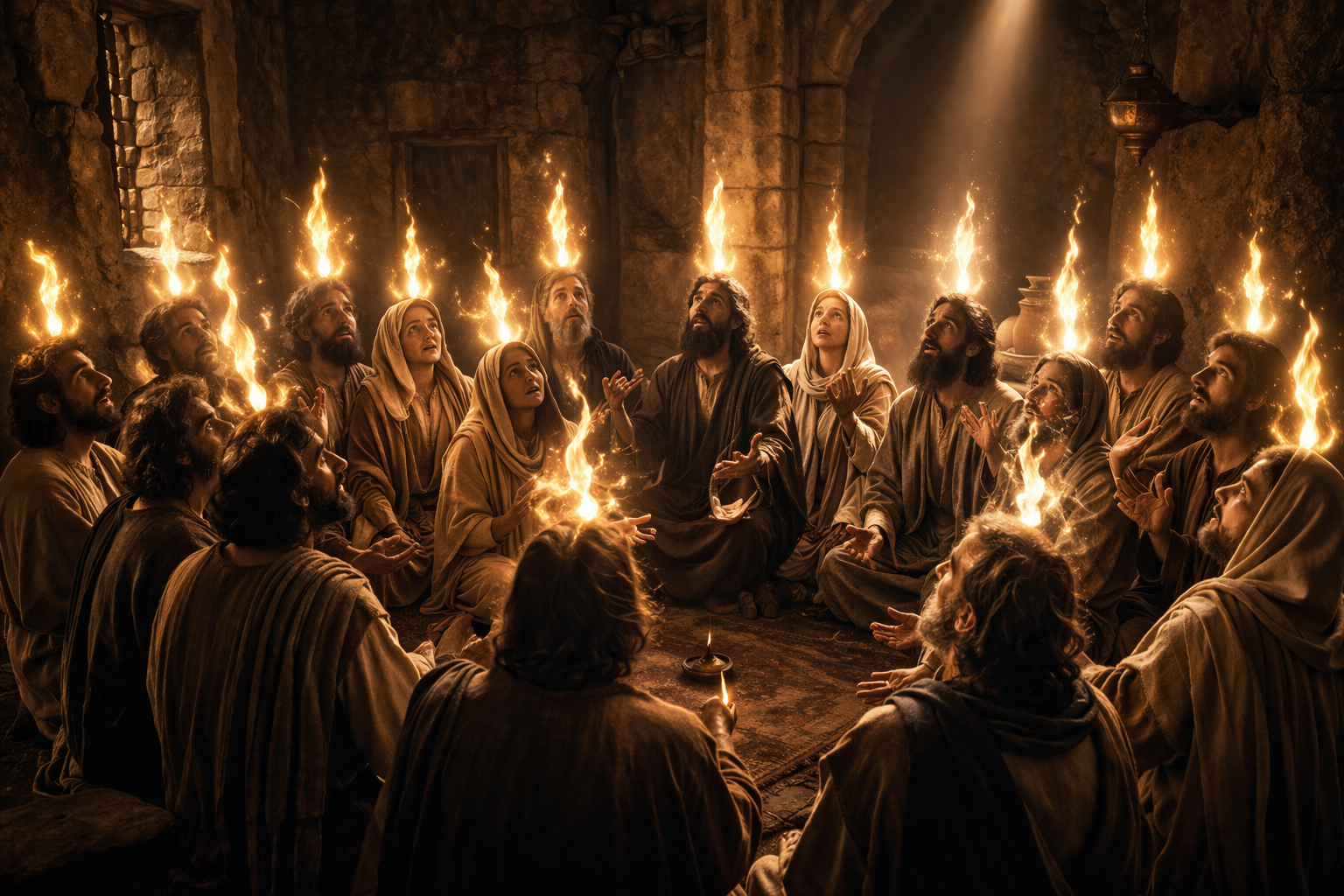
Centuries later, as the emissaries waited in the upper room in Yarushalayim, they were not merely passing time; they were diligently executing this exact mathematical count. They were holding the acoustic perimeter of unity, anticipating the exact chronological coordinate when the Heavens would open to fulfill the Renewed Covenant.
Because they adhered to the pure calendar, they were gathered together at the precise hour.
“And when the day of Shabu’ut was fully come, they were all with one accord in one place.”
— Ma’ashiym (Acts) 2:1
When the 50th day finally dawned on that Sunday morning, they were perfectly positioned. The Tzadokite chronometer struck the appointed hour, the 15th day of the Third Month arrived, and the transmission of the Ruach HaQudash descended like fire.
Study Path
Continue the Maw'adiym Path
Follow the next step in this appointed-time sequence through the linked Maw'adiym studies below. These connected articles help keep the full chronology, feast structure, and restoration flow together as one study path.